
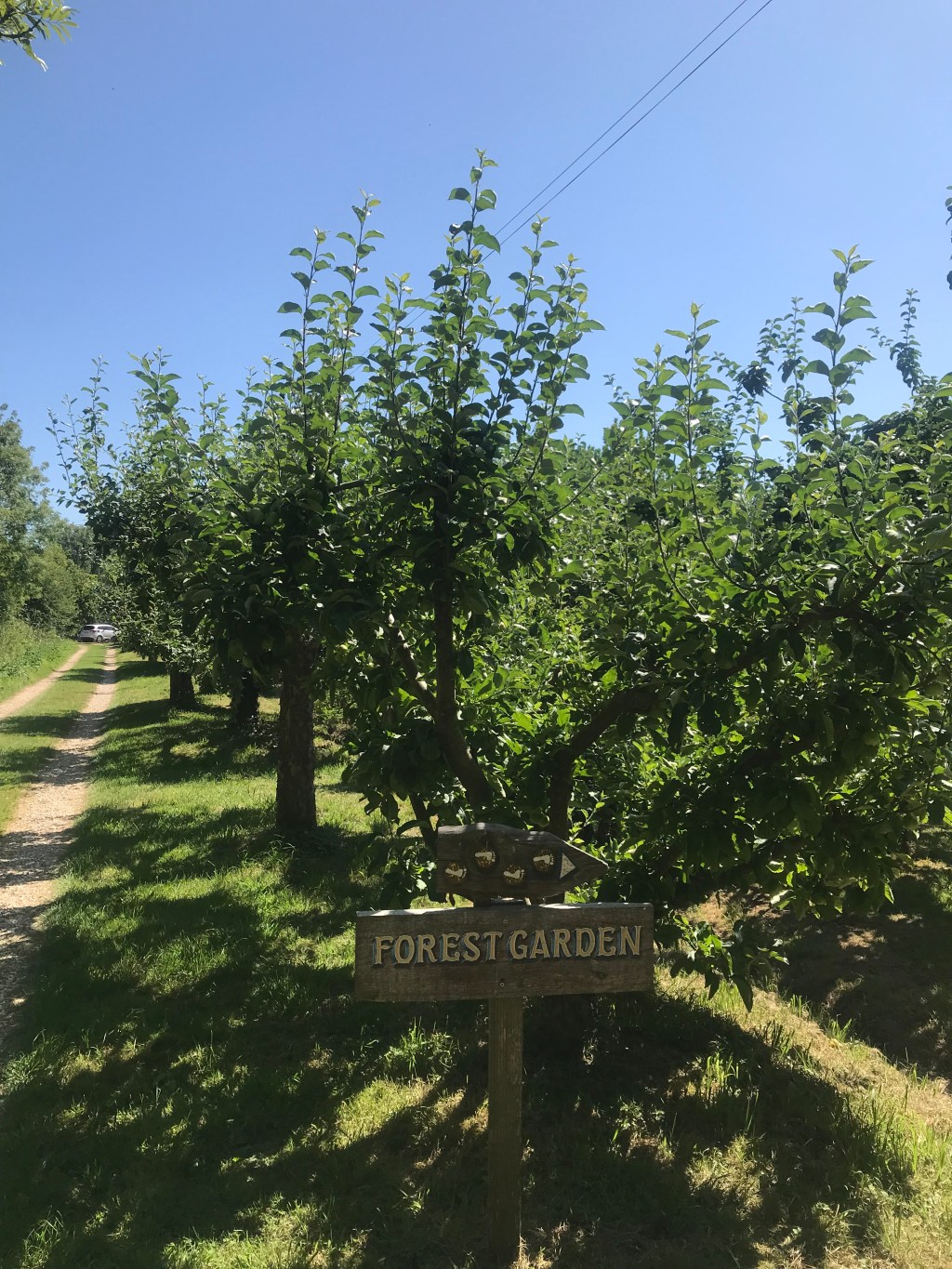
A forest garden, also often called a food forest, is not actually a garden in a forest. Rather, it is a way of gardening that takes its lessons from a forest ecosystem. In this way, plants can be grown together very productively while at the same time creating biodiverse and low-maintenance spaces. This is something anyone can emulate in their garden or even just a raised bed!
Forest garden systems are modelled on the structure of a young woodland. They are designed to mimick patterns of woodland succession. What does this mean? Well, if you think of a young woodland, they are places that consist not just of trees, but a wide range of different plants, because there is still enough light and space for a variety of shrubs and herbaceous plants to flourish. Then there are other areas which might be starting to get a bit more shady, creating the conditions for more shade-loving groundcover plants, for example. And then there is the woodland edge, which is a very biodiverse place: There will be smaller pioneer trees springing up everywhere, and also enough light and space for shrubs and herbaceous plants – often including thickets of brambles with their juicy blackberries! This makes great habitat for birds, insects and all sorts of mammals.
So, forest gardening aims to mimick these natural succession processes that create diverse habitats and food for humans and animals alike! They are a really good way of growing plants together productively, using all of the available space and creating a system where the plants benefit and support each other within a healthy ecosystem.
In terms of structure, a forest garden is made up of several different ‘layers’ of perennial plants growing at different heights. On paper, there can be as many as seven different layers: the canopy layer, the small tree layer, the shrub layer, the herbaceous layer, the groundcover layer, the root layer, and lastly the vertical layer, i.e. climbing plants that make use of vertical space.
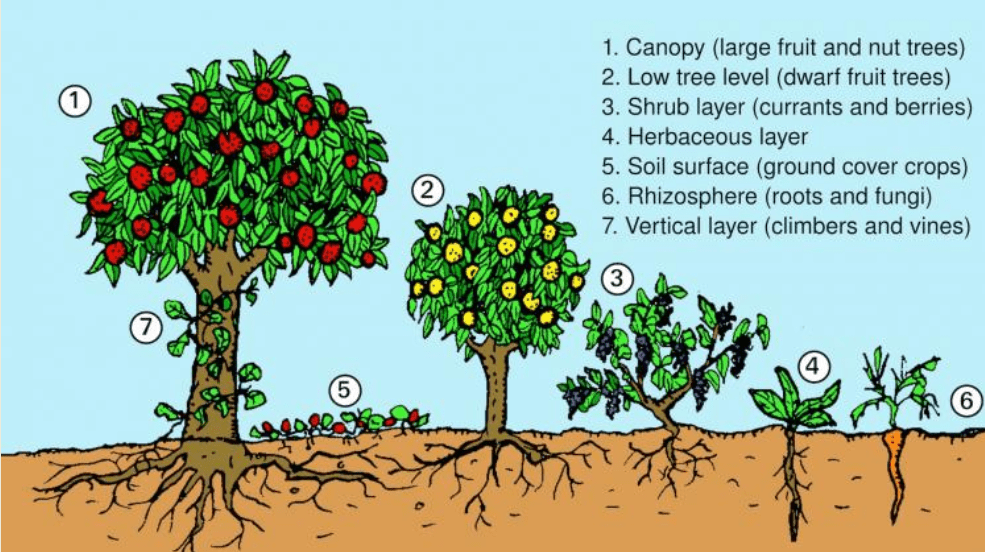
You don’t need to have all seven layers in a forest garden – the important bit is the concept of ‘stacking’. So, for example, you may only put in some redcurrants (the shrub layer), a few herbs (the herbaceous layer) and wild strawberries (the groundcover layer), particularly if you only have a small space and can’t plant any trees – but the whole system can still work according to the principles of a forest garden. By using mainly perennial plants and therefore keeping the soil covered and their roots in the ground (rather than growing new annuals every year, and keeping bare patches of ‘weed’-free soil in between them), you are not only improving the health of the soil and ecosystem, but are also making less work for yourself while reaping the fruits of your labour for years to come!
So, in short: Forest garden systems promote biodiversity, can yield a wide range of products, increase soil health and sequester carbon, to name but a few of their many functions. When designed well, they are self-supporting and low-maintenance (though not no-maintenance!), and best of all they are replicable on a small or larger scale – which is why I get so excited about them in an urban context, where space is usually at a premium!
One of my personal great inspirations on the theme of ‘Micro Forest Gardening’ is Pippa Chapman, who has produced some great resources on this topic, including a book called “The Plant Lover’s Backyard Forest Garden“. Check her out if this has piqued your interest.
The Permaculture Association and the National Forest Gardening Scheme also have some brilliant resources.
And not to forget some of the legends of forest gardening in this country: Martin Crawford of the Agroforestry Research Trust, as well as Tomas Remiarz, Robert Hart and Patrick Whitefield.
Permanent Publications sells a fab range of books on the subject.
Happy forest gardening!
 Fern & Branch Tree Care