

You may have noticed lots of galls around this year! Way more than you thought existed. This was the case for me anyway, and I learned a great deal just by observing some of the different galls popping up on the leaves of oak trees.
After finding the charmingly named ‘silk button spangle gall’, I‘ve also started noticing some flatter, reddish type galls, sometimes side by side on the same leaf with the silk buttons. My assumption therefore was that it was simply the same gall at a different stage in its cycle – but not so!
Silk button spangle galls are caused by the wasp Neuroterus numismalis. A tiny female wasp will remain inside the gall all through winter amongst the leaf litter until the following spring. When she emerges, she reproduces asexually, laying eggs in oak leaf buds and so starting a new spring generation!
Whereas the flatter ones are ‘common spangle galls’ which are caused by a different wasp: Neuroterus quercusbaccarum f. agamic. Well. They clearly don‘t mind sharing the same neighbourhood!
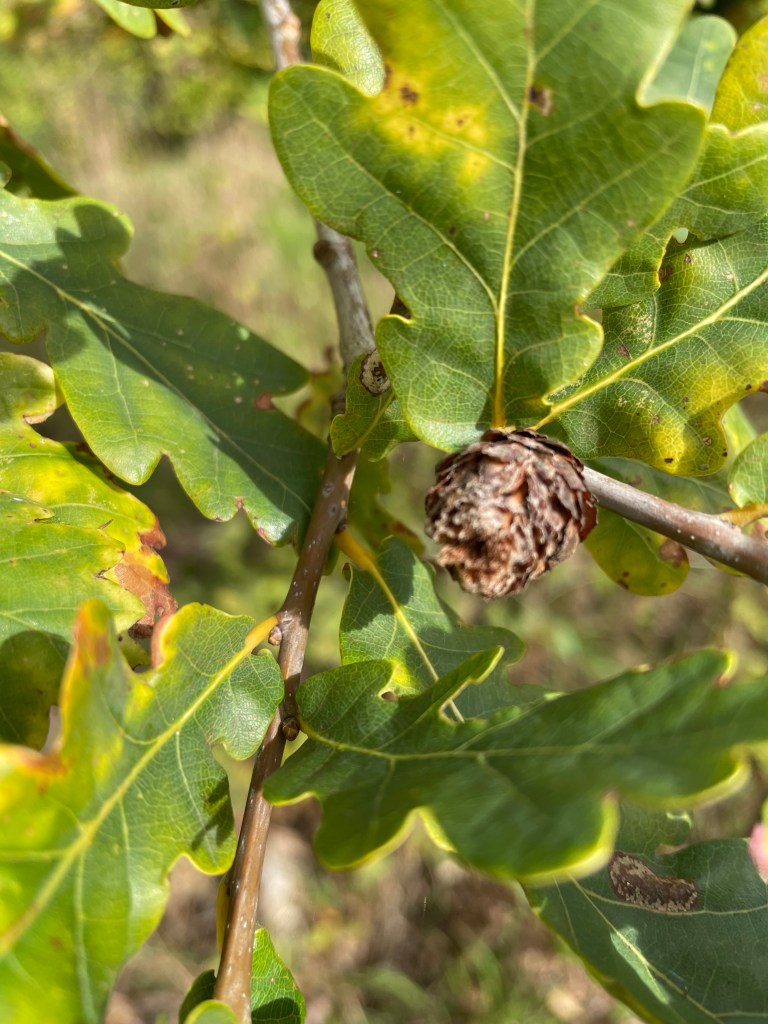
On the same oak tree, I also found what I believe might be an artichoke gall – caused by the wasp Andricus foecundatrix f. agamic. Apparently this gall has a cavity inside, containing the inner gall which is ejected in late summer, while the old gall persists with the bud scales opened out and brown (as in pic 2).
Who knew. Every day’s a gall day!

 Fern & Branch Tree Care